Various ways to print the content of hash in Perl

What is the various ways to print the contents of a hash?

Hash in Perl is nothing but an associative array i.e. Each key is associate with its value and can be displayed using either key or value. It is preferred over simpler array because instead of printing value based on index number, you can print by using key.
Ex:
[perl]$hash{'key'} = 'value';
[/perl]
We will discuss Hash fundamentals in another tutorial where I will explain everything which is required to understand hash clearly with some examples. Let’s see here, how we can display the contents of hash. We assume we have a hash defined as %hash = (some key value pairs);

How chomp and chop function works in Perl

How chomp and chop function works in PerlWhat is chomp and chop?
chomp()
The chomp() function will remove (usually) any new line character from the end of a string. The reason we say usually is that it actually removes any character that matches the current value of $/ (the input record separator), and $/ defaults to a new line. It returns the total number of characters removed from all its arguments and If VARIABLE is omitted, it chomps $_

So, if $/ =”\t” then chomp would remove every tab instead of new line.
 
For more information on the $/ variable, try perldoc perlvar and see the entry for $/ and perldoc -f chomp
Note: if chomp doesn’t behave as it should by default, hint is to check record separator ($/)

chop()
Sometimes you will find you want to unconditionally remove the last character from a string. While you can easily do this with regular expressions, chop is more efficient. Check perldoc -f chop
 
The chop() function will remove the last character of a string (or group of strings) regardless of what that character is and return the last character chopped. In case of array it return the last character chopped of the last element of the array. Note, if you want to easily remove newlines or line separators see the chomp().

As chop return the last character chopped of the string , if you want it's reverse i.e. return all characters except the last from the string you could use substr($string, 0, -1)
 
Chomp and chop, both functions can be applied on strings,array,hash. We would see it by three examples for each functions.
 
Example 1. Chomping a string
Most often you will use chomp() when reading data from a file or from a user. When reading user input from the standard input stream (STDIN) for instance, you get a newline character with each line of data. chomp() is really useful in this case because you do not need to write a regular expression and you do not need to worry about it removing needed characters.
When running the example below, using the enter key on a line by itself will exit the program.
 
[perl]#!/usr/bin/perl
  use strict;
  use warnings;
  my $username = <STDIN>;
  print "before chomp: $username";
  chomp $username; #or chomp($username); or chomp (my $username =<STDIN>); in one line
  print "After chomp: $username";[/perl] 
Output:
[vim][Sanjeev@Alien Coders]$ perl chomp_examples.pl
Alien Coders
before chomp: Alien Coders
After chomp: Alien Coders[Sanjeev@Alien Coders]$[/vim] 

First print got printed with new line which you entered while typing. Yes, it took new line (pressed enter) also as user input. Second line removed that new line, so second print is displayed along with shell on the same line.
 
Example 2. Chomping an array
If you chomp an array, it will remove  newline from the end of every element in the array:
 [perl] #!/usr/bin/perl
  use strict;
  use warnings;
  my @array = ("sanjeev\n", "Jassi", "AlienCoders\n");
  print "Before chomp:\n";
  print "@array\n";
  chomp(@array);
  print "After chomp:\n";
  print "@array\n";[/perl]
Output:
[vim]Before chomp:
sanjeev
 Jassi AlienCoders
 
After chomp:
sanjeev Jassi AlienCoders[/vim]
As you can see, the newlines have been removed from "sanjeev" and "AlienCoders", but no characters have been removed from "jassi".
 
Example 3. Chomping a hash
If you pass a hash into chomp() function, it will remove newlines from every value (not key) of the hash. Remember key is always unique and string (internally). So, if you add new line in key then use that new line char also while using that key. Better to avoid such nasty thing:
 
 [perl] #!/usr/bin/perl
  use strict;
  use warnings;
  use Data::Dumper;
 
my %hash = (
    'first' => "one\n",
    'second' => "two\n",
    'third' => "three\n",
  );
  print "before chomp:\n";
  print Dumper(\%hash);
  chomp(%hash);
  print "after chomp:\n";
  print Dumper(\%hash);[/perl]
Output:
[vim]before chomp:
$VAR1 = {
          'first' => 'one
',
          'second' => 'two
',
          'third' => 'three
'
        };
after chomp:
$VAR1 = {
          'first' => 'one',
          'second' => 'two',
          'third' => 'three'
        };[/vim]
It clearly shows that how new line is effective before chomp and it looks nice after chomp.
 
Example 4. Chopping a string
The chop() function removes and returns the last character from the given string whatever it is. So don’t do any mistake by assuming that it removed new line from the user input with its first use. When you will use it second time it will again remove one more character from user input but chomp only and only removes new line (or whatever is stored in $/).
 
  [perl]#!/usr/bin/perl
  use strict;
  use warnings;
 
  my $string = 'Perl';
  my $char = chop($string); #to return the chopped character in a variable
 
  print "String: $string\n";
  print "Char: $char\n";[/perl]
 
Output:
 [vim]String: Per
Char: l[/vim] 
 
Example 5. Chopping an array
If you pass the chop() function to an array, it will remove the last character from every element in the array.
 
  [perl]#!/usr/bin/perl
  use strict;
  use warnings;
 
  my @arr = ('Jassi', 'Sanjeev', 'Alien Coders');
  my $last_char = chop(@arr);
 
  print "@arr\n";
  print "Last Char: $last_char\n"; #it will store last character of last element in the array[/perl]
Output:
[vim]Jass Sanjee Alien Coder
Last Char: s[/vim] 

Example 6. Chopping  a hash
If you pass a hash into chop() function , it will remove the last character from the values (not the keys) in the hash. For example:
 
 [perl] #!/usr/bin/perl
  use strict;
  use warnings;
  use Data::Dumper;
 
  my %hash = (
    first => 'one',
    second => 'two',
    third => 'three',
  );
 
  print “Before chop:\n”;
  print Dumper \%hash;
 
  my $chr = chop(%hash);
  print “After chop: \n”;
  print Dumper(\%hash); 
 
  print "Char: $chr\n"; #it always have last character of last value in hash[/perl]
Output:
[vim]Before chop:
$VAR1 = {
          'first' => 'one',
          'second' => 'two',
          'third' => 'three'
        };
After chop:
$VAR1 = {
          'first' => 'on',
          'second' => 'tw',
          'third' => 'thre'
        };
Char: e[/vim]

Note:

  • chop and chomp functions would not work on array/hash reference or array of array/hash reference. So, avoid using this on referential things.
  • Always use parenthesis, if you are using assignment operator while chomping or chopping.
    chomp $value = <STDIN>;  doesn't work  but chomp($value=<STDIN>); works

Credit: http://perlmeme.org

Delete Function in Perl with examples

“delete” function in Perl is mainly used to delete the given element/key, which in return deletes its associated value(s) too. So, exists() on such key would return false.
Note: Assigning undefined value to a key in has doesn’t remove its key but delete() function would do that. So, use delete() or assigning undefined value wisely.
The general syntax for delete function is:
[perl]delete EXPR
[/perl]

How to send a mail using Perl and sendmail in Linux

sendmail in LinuxThere will be some situations where you will not be allowed:
  • to send mail outside of your company/organization
  • to open any mail client like Gmail, yahoo or Hotmail using browser

But you wish to send mail to your outside friend. Either you will use some proxy settings or will request administrator to allow sending or receiving any mail from outside. What if we can do it using an in-built command or through script?

Yes it is possible and its much more easy if you are using Linux rather than Windows (I know even now most of us are using Windows to read this article 😉 ).

This code will work only at Linux variants. If you want to use sendmail in Windows and Linux also with command line option instead of writing a Perl script, you need to download sendEmail readymade script written in Perl by Brandon Zehm  .

  • For Linux users, just untar it and run as you run other Perl script, provided your Perl interpreter is at /usr/bin/perl else change the path at script accordingly
  • For Windows users, extract the code and run it at command line. Make sure, you have installed Perl interpreter.

Lets see the explanation using codes:
[perl]
#!/usr/bin/perl
#################################################################################
#    Author: Sanjeev Jaiswal
#    Date: July, 2012
#    Description: This script will use inbuilt command “sendmail” with -t option mainly.
#                 You can send an email to anyone from any valid email id, even if its not you.
#                 You can use it to prank your friends too or to do some serious stuffs.
#################################################################################
use strict;
use warnings;
 
# You can put as many email ids as you wish in to, cc, bcc
# But, be sure to use commas under one string. All mail ids are fake here, used just for demo 😛
# except  admin@aliencoders.org 😉
my %config = (mail_from =>’ranjan2012@gmail.com’,
              mail_to => ‘jaszi@gmail.com, sanjeejas@gmail.com’,
              mail_cc => ‘jasse@gmail.com, jassi@hotmale.com’,
              mail_bcc => ‘nazibal700@gmail.com, jasze@gmall.com’,
              mail_subject => “Just testing Sendmail”
             );
 
#Call method to send preformatted email
mail_target();
 
sub mail_target{
   #Use \n\n to make sure that it will render as HTML format
   my $message = “From: $config{mail_from}\nTo: $config{mail_to}\nCc: $config{mail_cc}\nBcc: $config{mail_bcc}\nSubject: $config{mail_subject}\nContent-Type: text/html;\n\n”;
   $message.= “<strong>Hi Dear,</strong><br>If someone knows your email id, he/she can use it without your permission if he/she is using sendmail under Linux :D<br> Only issue is it says via which server. Through this you can find out from which server and location someone has used your email id.\n”;
 
   my $MAIL_CMD = “/usr/sbin/sendmail -t -i”;
   if(!open(SENDMAIL, “| $MAIL_CMD”)){
      print “Unable to open an input pipe to $MAIL_CMD:”;
      exit(1);
   }
   print SENDMAIL $message.”\n”;
   close(SENDMAIL);
}
[/perl]

If it gives error like Can’t exec “/usr/lib/sendmail” then :
  • Verify if you are using right sendmail path by using which sendmail command at linux box. You can see the sendmail path.
  • If it says no command found then, type whereis sendmail and you will surely get the lists of sendmail. Use any of these.
You can hide the server and host information also. But you may see This message may not have been sent by:  if its Gmail or any good email clients 😀
 
Any alternatives?
Yes, try any of these listed modules in Perl:
How we can trace out that this mail is from the original sender or someone used his/her id using such scripts?
If you click at show original option under Gmail, you can see, who sent you the mail and from where you got the mail.
Tips:
  • You can use anyones email id at from section but use yours only. I used my friends id to prank them (but its not ethical though)
  • It even didnt check mail existence so you can  write from email address as bill-gates@msft.com
  • In case you forgot to use proper email format like bill-gates instead of bill-gates@msft.com then it would embed its server name as domain name like bill-gates@your-server-name.com
  • You can even attach files
  • You can send mails to many under to, cc and bcc. (Usually to should have only one email id)
Note: Use it to send mail from your mail id only. Using others identity for wrong doing is an offensive crime. Do those things at your own risk. Our work was to make you aware about working sendmail only. (Never say that I didnt warn you before doing anything unethical)
 
How we can hide host name so that no one can get the original trace even using header information.
With the help of masquerading, your outgoing email would appear  from user@aliencoders.org instead of realunixuser@server01.aliencoders.org. This will also hide your internal user name or host name from rest of the world!
So this feature rewrites the hostname in the address of the outgoing mail. This can also be used when you have centralized mail server i.e. mail hub.

Masquerading Sendmail configuration (sendmail.mc not sendmail.cf)
Open your sendmail config file which will be located at  /etc/mail/sendmail.mc:

[vim]
# vi /etc/mail/sendmail.mc
[/vim]

Append/add/modify these lines as follows: (usually these lines will be commented, so just uncomment it)
[vim]
MASQUERADE_AS(aliencoders.org)dnl
FEATURE(masquerade_envelope)dnl
FEATURE(masquerade_entire_domain)dnl
MASQUERADE_DOMAIN(aliencoders.org)dnl
[/vim]
 

Save and close the file. Replace domain name aliencoders.org with your actual domain name. Update and restart sendmail server (use as root):

Before restarting the server, lets sendmail.inc make sendmail configuration file ready using m4 command. The m4 utility is a macro processor intended as a front end for C, assembler, and other languages. Type man m4 in Linux box for more details. So, dont edit sendmail.cf manually.

[vim]
# m4 /etc/mail/sendmail.mc > /etc/mail/sendmail.cf
# /etc/init.d/sendmail restart
[/vim]
 

Done! Now you can hide your real user name, server details and can enjoy this beautiful feature of Linux. (Do pranks or unethical things at your own risk 😉 )

Disclaimer: This article is for educational purpose only. We are not responsible if you get sued or fired from your company while using this script or such knowledge. Use it at your own risk!

Methods to Install Perl modules from CPAN

Installing Perl modules from CPANIf you are working on Perl and you need to work on modules which is listed in CPAN. You may need to download it, install it and use it in your box.

For that you need to know how to install Perl modules. This article will show you simple steps to download and install Perl modules in Linux box. I know its not the new topic for Perl chapter but I wrote it for our standalone repository on Perl and moreover, all these method with examples and pitfalls are not listed at many places. So, I think it will be worthy for our viewers and Perl mongers 😀

Method 1 using cpan shell(It has advantage over manual installation. Read Note section at the bottom)

1. perl -MCPAN -e shell
cpan> install HTML::Template
or
2. perl -MCPAN -e ‘install HTML::Template’
or
3. cpan -i  MIME::Lite

Method 2 Manual module installation
if you’re having problems installing with CPAN. If you’re on the command line, you can use something like wget to grab the file. Next you’ll want to unzip it with something like:

tar -zxvf HTML-Template-2.8.tar.gz

In case above command doesnt work for you, try this
gzip -d XML-Parser-2.36.tar.gz
tar -xvf XML-Parser-2.36.tar

This will unzip the module into a directory, then you can move in and poke around – look for the README or INSTALL files.

In most cases, installing a module by hand is still pretty easy, though (although not as easy as CPAN). Once you’ve switched into the base directory for the module, you should be able to get it installed by typing:(I assume you are on Linux box)
1. perl Makefile.PL
2. make
3. make test
4. make install

If everything shows fine then Thats it. You are now ready to rock and roll with newly installed Perl modues 😀
 

But what if cpan command doesnt work for method 1?
1. Check first if cpan command works in your box
$cpan
cpan: Command not found.
If you get the above result means you need to install cpan module to work from CPAN otherwise, you have cpan installed in your system and you can skim next steps 😀

2. yum install perl-CPAN

3. after successful download and installation. Type cpan for the first time use
and type o conf commit on cpan prompt
then type quit on cpan prompt

You are done!  Now Method 1 will work without fail.


Note: If any CPAN module is dependent on the several other modules. CPAN automatically resolves the dependencies and installs other dependent modules. 

cpanm module is more advanced for doing all these without hassle. If possible give it a try.

[ADDED LATER]
As it was commented through Facebook by one of our readers, so I thought to better update this article with his comments.

# Install cpanminus (once).
curl -L http://cpanmin.us | perl – –self-upgrade or
cpan App::cpanminus
# Install your CPAN modules.
cpanm HTML::Template
cpanm XML::Parser
 

Sorting an array and hash elements in Perl

Sorting in PerlSorting an array and hash elements in Perl
This is the answer to Ques# 17 (a) and 23  under Perl Basics in Perl Interview Questions
There are many situations when we need to display the data in sorted order. For example: Student details by name or by rank or by total marks etc. If you are working on data driven based projects then you will use sorting techniques very frequently.
In Perl we have sort function which sorts a list alphabetically by default. But there is not the end. We need to sort:

  • an array numerically or
  • case insensitive strings or
  • case sensitive strings
  • hash contents by keys or
  • hash contents by values or
  • reverse of all above said points
 
How sorting  works in Perl
Sort subroutine has three syntaxes and last one is the most used syntax.
  • sort SUBNAME LIST
  • sort BLOCK LIST
  • sort LIST
In list context, it sorts the LIST and returns the sorted list value. In scalar context, the behavior of sort() is undefined.
If SUBNAME or BLOCK is omitted, sorts in standard string comparison order.

Standard string comparison means based on ASCII value of those characters. Like @arr = qw (Call all). In this case it will be sorted as Call all which was not expected. So to make it work properly we use case-insensitive sort.

 If SUBNAME is specified, it gives the name of a subroutine that returns an integer less than, equal to, or greater than 0 , depending on how the elements of the list are to be ordered. (The <=> and cmp operators are extremely useful in such routines.)

Note: The values to be compared are always passed by reference and should not be modified . $a and $b are global variable and should not be declared as lexical variables.

sort() returns aliases into the original list like grep, map etc  which should be  usually avoided for better readability.
As sorting always does string sorting, so to do numeric sorting we need to use a special syntax which a sort {$a $b} LIST. We will see these conditions using Perl codes.
 
How reverse sorting works
Systax to use reverse sort is reverse LIST. It works on sorted LIST usually. But in scalar context, it concatenates the elements of LIST and returns a string value with all characters in the opposite order.
In scalar context if argument is not passed it will reverse the value of $_

Ex:  

[perl]$_ = “dlrow ,olleH”;

print scalar reverse;  #in this case print reverse would not works because it expects a LIST  
[/perl]

How <=> and cmp work?
These are actually binary equality operator. Binary operator usually gives (0 or 1) or (true or false)  but these gives three values based on the comparison result.
Binary  “<=>” returns -1, 0, or 1 depending on whether the left argument is numerically less than, equal to, or greater than the right argument.
Binary “cmp” returns -1, 0, or 1 depending on whether the left argument is stringwise less than, equal to, or greater than the right argument.
Never mix string and numeric values in LIST else sorting result will be fearsome 🙁

Try this out:
[perl]
my @arr1 = qw(1 two 3 0 4  Two 5 six 7 8 9 ten);
my @arr2 = sort {$a cmp $b} @arr1;
print “\n@arr2\n”;
[/perl]
Let go through the codes for different scenarios:
Example 1: Sorting  an array of strings (case-sensitive and case-insensitive examples)
[perl]   
#!/usr/bin/perl
    use strict;
    use warnings;
 
    my @strarr = qw(two Two six Six alien Coders Alien coderS);
    my @sorted = sort {$a cmp $b} @strarr; # same result as of sort @strarr
    my @sortedcase  = sort { uc $a cmp uc $b } @strarr; #case-insensitivie
    print “\n@sorted\n@sortedcase\n”;
 [/perl]
Output:
 
Alien Coders Six Two alien coderS six two
alien Alien Coders coderS six Six two Two
 
Note: try to always use case insensitive for better string sorting results.
 
Example 2: Sorting an array of numbers
The Perl sort function sorts by strings instead of by numbers. If you do it in general way it would fetch unexpected result.
   [perl] #!/usr/bin/perl
    use strict;
    use warnings;
 
    my @numbers = (23, 1, 22, 7, 109, 9, 65, 3, 01, 001);
 
    my @sorted_numbers = sort @numbers;
    print “@sorted_numbers\n”;
[/perl]
The output you would see would be:
    001 01 1 109 22 23 3 65 7 9

To sort numerically, declare your own sort block and use the binary equality operator i.e. flying saucer operator <=>:
  [perl] 
   #!/usr/bin/perl
    use strict;
    use warnings;
 
    my @numbers = (23, 1, 22, 7, 109, 9, 65, 3, 01, 001);
 
    my @sorted_numbers = sort {$a <=> $b} @numbers;
    print “@sorted_numbers\n”;
[/perl]
The output would now be:
    1 01 001  3 7 9 22 23 65 109
Note that $a and $b do not need to be declared, even with use strict on, because they are special sorting variables.

Example 3: Sorting array backwards (for string and numbers)
To sort backwards you need to declare your own sort block, and simply put $b before $a. or use reverse keyword after simple sort.
For example, the standard sort is as follows:
 [perl]   #!/usr/bin/perl
    use strict;
    use warnings;
 
    my @strings = qw(Jassi Alien Coders);
 
    my @sorted_strings = sort @strings;
    print “@sorted_strings\n”;
[/perl]
The output would be:
    Alien Coders Jassi

To do the same, but in reverse order:
[perl] 
  #!/usr/bin/perl
    use strict;
    use warnings;
 
    my @strings = qw(Jassi Alien Coders);
 
    my @sorted_strings = sort {$b cmp $a} @strings; # or reverse sort @strings
    print “@sorted_strings\n”;
[/perl]
The output is:
Jassi Coders Alien

And for numbers:
[perl] 
  #!/usr/bin/perl
    use strict;
    use warnings;
 
    my @numbers = (23, 1, 22, 7, 109, 9, 65, 3);
 
    my @sorted_numbers = sort {$b <=> $a} @numbers; # or reverse sort {$a $b} @numbers
    print “@sorted_numbers\n”;
[/perl]
The output is:
    109 65 23 22 9 7 3 1
This was all about sorting array elements alphabetically or numerically. Now we will see how sorting works on hash elements.

Example 4: Sorting hashes by keys
You can use sort to order hashes. For example, if you had a hash as follows:
Suppose we want to display the members for each community sorted alphabetically or say by keys, then this code will do so:
[perl] 
  #!/usr/bin/perl
    use strict;
    use warnings;
 
    my %members = (
        C => 1,
        Java => 7,
        Perl => 12,
        Linux => 3,
        Hacking => 8,
    );
foreach my $language (sort keys %members) {
        print $language . “: ” . $members{$language} . “\n”;
    }
[/perl]
Output:
    C: 1
    Hacking: 8
    Java: 7
    Linux: 3
    Perl: 12

If you want to sort the same hash by the values (i.e. the users beside each programming language), you could do the following:
[perl]
    #!/usr/bin/perl
    use strict;
    use warnings;
 
    my %members = (
        C => 1,
        Java => 7,
        Perl => 12,
        Linux => 3,
        Hacking => 8,
    );
    # Using <=> instead of cmp because of the numbers
    foreach my $language (sort {$members{$a} <=> $members{$b}} keys %members){
                print $language . “: ” . $members{$language} . “\n”;
}
 [/perl]

Output:
    C: 1
    Linux: 3
    Java: 7
    Hacking: 8
    Perl: 12

Example: 5 Sorting complex data structures
We can also use sort function to sort complex data structures. For example, suppose we have an array of hashes (anonymous hashes) like:
[perl] 
  my @aliens = (
        { name => ‘Jassi’, age => 28},
        { name => ‘Somnath’, age => 27},
        { name => ‘Ritesh’, age => 24},
        { name => ‘Santosh’, age => 29},
        { name => ‘Ranjan’, age => 26},
        { name => ‘Kaushik’, age => 25},
    );
[/perl]
And we wish to display the data about the people by name, in alphabetical order, we could do the following:
[perl] 
  #!/usr/bin/perl
    use strict;
    use warnings;
 
    my @aliens = (
        { name => ‘Jassi’, age => 28},
        { name => ‘Somnath’, age => 27},
        { name => ‘Ritesh’, age => 24},
        { name => ‘Santosh’, age => 29},
        { name => ‘Ranjan’, age => 26},
        { name => ‘Kaushik’, age => 25},
    );
 
    foreach my $person (sort {$a->{name} cmp $b->{name}} @aliens) {
        print $person->{name} . ” is ” . $person->{age} . “\n”;
    }
[/perl]
The output is:
    Jassi is 28
    Kaushik is 25
    Ranjan is 26
    Ritesh is 24
    Santosh is 29
    Somnath is 27

Sorting the same hash by age and using a subroutine (inline function)
Rather than writing the code inline, you can also pass in a subroutine name. The subroutine needs to return an integer less than, equal to, or greater than 0. Do not modify the $a and $b variables as they are passed in by reference, and modifying them will probably confuse your sorting.
[perl]  
#!/usr/bin/perl
    use strict;
    use warnings;
 
    my @aliens = (
        { name => ‘Jassi’, age => 28},
        { name => ‘Somnath’, age => 27},
        { name => ‘Ritesh’, age => 24},
        { name => ‘Santosh’, age => 29},
        { name => ‘Ranjan’, age => 26},
        { name => ‘Kaushik’, age => 25},
    );
 
    foreach my $person (sort agecomp @aliens) {
# it just replaced {$a->{age} <=> $b->{age}} by agecomp inline function
        print $person->{name} . ” is ” . $person->{age} . ” years old\n”;
    }
 
    sub agecomp {
        $a->{age} <=> $b->{age};
    }
[/perl]
The output would be:
    Ritesh is 24 years old
    Kaushik is 25 years old
    Ranjan is 26 years old
    Somnath is 27 years old
    Jassi is 28 years old
    Santosh is 29 years old

To find out more on sort function,  run the command on Linux box:
    perldoc -f sort



How to move or copy a file using Perl

There can be n number of ways to copy or move a file using Perl programming. Like invoking system command or using Linux or windows system command through backtick. But I found using a module called "File::Copy", nice and cleaner way to accomplish the task. It will take care of Operating System issues and other dependencies.
And the good thing is, it's available in core Perl!

So we will use File::Copy module and will call copy() function to copy the file and move() function to move the files.

Ok then, How it works?

Finding the length of an array and a hash

Learn PerlDetermining the length of an array and a hash

If you are working on Perl, then you will need to find the length or size of an array, hash, and array/hash elements very often.
Meaning of Size or length depends upon for which context you are talking about.  Generally it means the number of characters in a string, or the number of elements in an array/hash.
But, if you are using Unicode characters then the number of characters in a string may be different to the number of bytes in the string. So the in-built function length may give different result for different context.

We will see it by using different examples based on different problems:

Example 1. Finding length() of string
To determine the number of characters in an expression use the length() function:
    [perl]#!/usr/bin/perl
    use strict;
    use warnings;
 
    my $name = 'Jassi';
    my $size = length($name);
 
    print "$size\n";
    exit 0;[/perl]
This example prints the number of characters in the string $name:
    5

Example 2. Find the bytes used by string using length()
What, if you want to know the bytes occupied by the string not the characters it holds?  This may not matter if  you are using ASCII characters but it may, if you are using Unicode characters.
By default the length() function returns the number of characters. You can tell it to return the number of bytes by specifying use bytes; in the program as in this example:
  [perl]  #!/usr/bin/perl
     use strict;
    use warnings;
 
    my $char = "\x{263a}";    # A smiley face
    {
         use bytes;
        my $byte_size = length($char);
        print "Bytes: $byte_size\n";
        no bytes;
    }
    # Character size here
    my $size = length($char);
    print "Chars: $size\n";
     exit 0;[/perl]
This outputs:
    Bytes: 3
    Chars: 1
 
Note: either use closure or whenever you use “use bytes” try to use “no byets” once you are done

Number of element in an array
Example 3: using array’s last index
In Perl you can determine the last element of an array easily ($#array_name) and add 1 to it to find the number of elements in that array.
   [perl] #!/usr/bin/perl
    use strict;
    use warnings;

my @alien_members = qw(jassi Ritesh Ranjan som Santosh);
    my $size = $#alien_members + 1;
    print "$size\n";
    exit 0;[/perl]
This gives us:
    5
Example 4.  Using scalar context of an array
If you assign an array to a scalar variable, it will return the number of elements of that array:
  [perl]  #!/usr/bin/perl
     use strict;
    use warnings;
 
    my @alien_members = qw(jassi Ritesh Ranjan som Santosh);
    my $size = @alien_members;
 
    print "$size\n";
    exit 0;[/perl]
This gives us:
    5
Apart from being confusing to read, this method can lead to some easy mistakes. For example, consider the following program:
   [perl] #!/usr/bin/perl
     use strict;
    use warnings;
 
     my @alien_members = qw(Jassi Ritesh Ranjan som Santosh);
    print "@alien_members\n";
    print @alien_members."\n";
     exit 0;[/perl]
What would you expect it to print?
Each array elements to a new line like
Jassi
Ritesh
Ranjan …
Nope it would print
Jassi Ritesh Ranjan som Santosh
5
When double-quotes included, it treats arrays differently. The double-quotes cause Perl to flatten the array by concatenating the values into a string. So behind the stage, something like this happened.
“Join each array element by space and assign it to a scalar variable. So it became a string.” It is something like $size = “@alien_members”; which will differ from $size = @alien_members;

try to print these two statements and see the difference.
 But check second print output. Isn’t it strange?

Example 5. Arrays: never use length() to find the number of elements in an array.
You have seen  the use of length at Example#1 but still If you try to use the length() function on an array, it won't give you the desired output.
    [perl]#!/usr/bin/perl
 
    use strict;
    use warnings;
 
    my @alien_members = qw(Jassi Ritesh Ranjan som Santosh);
    my $size = length(@alien_members);
     print "$size\n";
    exit 0;[/perl]
The output is not what you thought:
    1
This is because the length() function requires a scalar, so the array is forced into scalar context.
And we saw already (example 4) that an array in scalar context already gives us the length. The example above is giving us the length of the length i.e. the length of 5 is 1. Hope it makes sense!

Example 6. Finding the number of elements using scalar() function
No doubt that Example 3 and 4 are correct but they aren't much clear and friendly to use in our program (readability problem you can say). Perl has the scalar() function which forces the array into scalar context which will give you the length of an array (even hash too):
   [perl] #!/usr/bin/perl
 
    use strict;
    use warnings;
 
    my @alien_members = qw(Jassi Ritesh Ranjan som Santosh);
    my $size = scalar(@alien_members);
 
    print "$size\n";
    exit 0;[/perl]
This also gives us the correct answer:
    5

Example 7. Finding the number of elements in a hash
Sometimes you will also want to have the number of elements of a hash. This is easily done using the keys() function to return the keys as an list, and the scalar() function to return how many keys there are (it is very common question in interviews too):
  [perl]  #!/usr/bin/perl
 
    use strict;
    use warnings;
 
    my %alien_members_rank = (
        Jassi => 1,
        Ritesh   => 2,
        Ranjan   => 3,
        Somnath    => 5,
        Santosh => 4
    );
    my $size = scalar(keys %alien_members_rank);
 
    print "$size\n";
    exit 0;[/perl]
The output of this program is:
    5
Note: it will not give 10 as you might have thought in context of an array. It can give you no of keys elements and then you can just multiply it by 2 😀

For more details on these functions, see also
    perldoc -f length
    perldoc -f scalar
    perldoc bytes


Minimal Introduction on Regular Expression

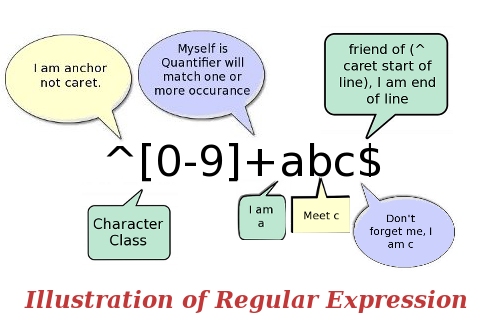
Regular expression IllustrationMinimal basics on Regular Expression (Non-technical )

This article is for those who have graduated from Computer Science background or have basic knowledge of natural language processing concepts. I will not share any coding stuffs in this post and all basic rules with examples will be posted in next article.
 In our graduation time we had one paper called Theory of Automata which dealt with NFA, DFA etc. There we had used some magic/wildcard symbols to complete the expression. Like “^(a|b*)+ababa?cd$”  I know it looks nothing more than a junk to a common man but it does lots of such things which saves our time and effort in real life of programming world.   Whatever you saw, was nothing but a small example of regular expression.

What is regular Expression?
It is a method to manipulate set of strings which is in some order or which makes some sense in real use. It is also called as pattern.  It provides a method to match, substitute, and transliterate set of patterns, text, strings. In programmers world it is also being called as regex or regexp.
Ex: All corrupt politicians substituted by honest politicians. We just need to use the pattern: s/corrupt/honest/ig

That’s it! Now our nation has all honest politicians in the world of regular expression. This was just a small example. It can do a lot. (Think about it -> sochiye jara :P.  It’s very famous phrase now in Indian television advertisement 😉 ) Of course to use this small but damn powerful tool, we need to follow some sets of rules which I will try to cover in my next article as its continued part.

Why Regular Expression?
Whenever we need to do something with the text, regex’s magic can be useful. Almost all text editors use regular expression to manipulate text contents. Like find something in a file or replace a pattern with new pattern etc.  For example:

  • replace all carbonate to polycarbonate
  • Find all coders word in a file. It should not match aliencoders, decoders, and encoders. It should match only coders
  • Replace nasty characters from Unix file which came from windows files like ^M
  • Find all Cisco Pix Firewall from different firewall products
Where we can use Regular Expression?
  • It can be used anywhere, where we need to manipulate a text file, set of strings using a pattern. It is being used in almost all the programming languages and Perl is a well-known language whose power lies behind regex.
  • It is being used in text editors, even in MS Word
  • If you want to replace a word, say by mistake you wrote gray instead of grey and it is having more than 50 such occurrences in a file. Just write a pattern and use it. Ex: s/gray/grey/ig.  It will change all gray to grey in a fraction of seconds.
  • You can save many lines by using regular expression rather than using nested if else.
  • If it’s Perl then you can use code also, instead of just a string pattern. You need to use x modifier for that.
  • One can use regular expression in grep and map function in Perl which can save many lines of codes ( an alternative to loop structure with if else conditions ). There are lot more instances.
  • Regular expression is used by all level of programmers from different programming language domain like C#.NET, JavaScript, Perl, Python, PHP
  • For Syntax highlighting, data validation using regex in your codes
  • Even search engines like Google also uses Regular Expressions.
Where we can avoid regular expression?
  • If work can be done using simple if else or loop. Ex: do ip address validation (1-3 digit in four octet) and then use if else to check octets lies between 0-255 range or not.
  • If you are using backtrack with greedy search, beware of using it. It may hang your system
  • If you need to use regex anyhow , then don’t try to put all things in one complex regex
  • It’s very powerful tool, if used wisely. Always try to use minimal greedy pattern like .*? instead of .*
What are the basic elements to learn in Regular Expression?
There are lots of things to learn to start writing regex from the scratch but If you get familiar with some of its technical terms and its meaning, then writing and understanding complex regex will be easy.
  • Character class: whatever you use inside [] will be treated as range with or options  i.e [a-z0-9A-Z] which means anything from a to z or A-Z or 0 to 9
  • Meta characters (special characters) : character that has special meaning in regular expression other than simple meaning. Like + in regular expression world means one or more occurrence not a simple addition. other examples are \w,\d,\S,.,\t, ^, $, |
Note: ^, $, \A,\Z, \<,\> are also called as anchors because it decides the start and end position in the pattern
  • Quantifier or range operators: It is used for defining range of the pattern like one or more, at least 2 or more, between 3 and 8 Ex:
    • \d{3,} means at least 3 digits or more  (ha){3} matches 3 ha i.e. hahaha (shortcut to laugh (he){3} -> hehehe 😛
    • \w +  means one or more occurrence of alphanumeric character including ‘_’
    •  Other quantifiers are ?, *, {} (Hint: greedy, non-greedy used for these)
  • Modifier or (pattern modifier): used after that pattern to modify the working of regular expression
    • Ex: s/old/new/ig means substitute old to new wherever it finds the word old with case insensitive property
    • Other modifiers are i.e. m,i,c,x,g ,d,s,o  etc which depends upon regular expression operators. Like e modifier can be used only for substitute regex operator
  • Saving the matched pattern using grouping pattern i.e. (\d+), if matched will be saved in $1
  • Regular Expression operators: it defines that the pattern is for matching or searching or transliteration i.e. m, s, tr
  • Other terms like greedy pattern, non-greedy pattern, backtrack etc. Like how .* and .*? works
That’s all for now.  I hope you can understand now about the basic use and technical terms used in regular expression. I will explain all such terms in details using Perl programming language in my next post

How to find the list of installed modules in Perl

This is one of the questions asked in many Perl related job interviews. See the question here: http://www.aliencoders.org/content/interview-questions-perl-freshers-and-experienced
There will be some situations when you will need to know about installed modules, its version or you may need to check if required module is installed or not with mentioned version or higher than that.

Here are few ways through which you can achieve the result that I found over the internet from different websites.

1. To list all installed Perl modules using perl script

[perl]
#!/usr/bin/perl   #change the path  with your perl location
use strict;
use warnings;
use ExtUtils::Installed;  # By default this module will be available in Perl

my $instmod = ExtUtils::Installed->new();
foreach my $module ($instmod->modules()) {
    my $version = $instmod->version($module) || “Version Not Found.”;
    print “$module version=$version \n”;
}
[/perl]

2. To list installed Perl modules using command line in Linux box

Try instmodsh command in linux box
and then type l to list modules or m to give particular module name or q to quit

[code] $ instmodsh[/code]

Output:
[code]Available commands are:
l            – List all installed modules
m    – Select a module
q            – Quit the program
cmd?[/code]
At cmd? prompt type l to list all installed modules:
[code]cmd? l[/code]
Output:
[code]Installed modules are:
Archive::Tar
CPAN
Compress::Zlib
MIME::Lite
Module::Build
Net::Telnet
PAR::Dist
Perl
Spiffy
Test::Base
Test::Simple
XML::Simple
cmd?
[/code]

This command itself is a perl script that use ExtUtils::Installed module. Try following command to see its source code:
[code]$ vi $(which instmodsh)[/code]
For more details, visit this link: http://perldoc.perl.org/instmodsh.html

3. To compare and check installed Perl modules with respect to given modules with its version

[perl]
#!/usr/bin/perl
use strict;
use warnings;
my @modules = ([‘SOAP::Lite’, 0.50],
           [‘IO::Socket’, 0],
           [‘HTML::Parser’, 3.26],
           [‘LWP’, 5.65],
          );

print “\n”,
      “==========================\n”,
      “Testing for the given  Perl modules\n”,
      “===========================\n”;
      
    for my $arr_ref (@modules) {
        my($mod, $ver) = @$arr_ref;
        print “$mod” . ($ver ? ” (version >= $ver)” : “”) . “\n”;
        
        eval(“use $mod” . ($ver ? ” $ver;” : “;”));
        if ($@) {
            my $msg = $ver ?
                      “\tEither it doesn’t have $mod installed,\n” .
                      “\tor the version that is installed is too old.\n” :
                      “\tIt does NOT have $mod installed.\n”;
            print “$msg\n”;
        }
        else {
            print “\tYour system has $mod installed ” .
                  “with version @{[ $mod->VERSION ]}\n\n”;
        }
    }

print “Module Testing Done!\n”;
[/perl]

Note: If you are putting module name dynamically, then use  @{[ $mod->VERSION ]} for version number
else $Module-Name::VERSION ex: $SOAP::Lite::VERSION

[perl]
print “SOAP::Lite Version is “. $SOAP::Lite::VERSION.”\n”;
#or
 print “$mod version is @{[ $mod->VERSION ]} \n”;
 [/perl]

4. To list Perl modules that comes preinstalled with the standard Perl package and installed from outside
[perl]
perldoc perlmodlib #lists all the modules that come with standard Perl package already
perldoc perllocal #lists all modules that is installed from outside
[/perl]
Both modules reveal lots of information about each installed modules like installation date, directory, module version etc.